
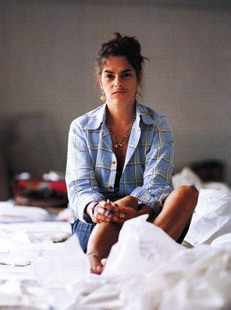
Modern Painters
June 2005
Karen Wright: Your new work marks something of a departure for you. Can you tell me how it all started and why you wanted to do it?
Tracey Emin I'm not someone who only works when they have a show; I work all the time and my work sells all the time. So, when it was decided that I would have a show at White Cube this June (my first for four years) it was great -- I had all these blankets I was working on -- but at the same time, I was aware that my brain had been going somewhere else. Then, on Valentine's Day, I had a mini nervous breakdown and forgot where I lived. I forgot I had a cat, I forgot all this stuff. It was really strange. It was like being completely outside of myself. After that, I decided that I wanted to postpone the show -- I wanted to get my head together and make a whole new body of work, something more in line with the way I was thinking. I said 'I don't want to do a show if I don't have a dialogue with what I am doing'. So the final decision about whether the show would go ahead or not was left open for about a week, and then I just started working and that was it. It was like drawing a line under something.
KW There seem to have been times in your career when you have stepped back and taken stock of things -- in 1996, for instance, when you completed Exorcism of the Last Painting I Ever Made while locked in Galleri Andreas Bränd-strom in Stockholm. Have you reached a similar point now?
TE I've got to be an artist, it's all I've got. I need God like I need art; I need art like I need God. You can't always take your talent or your gift for granted. You have to really work at it and you have to push yourself and rationalize what you're doing. It's great to have a commercial market but it's no good having that as your justification for what you do. Everyone wants colourful, charged blankets from me. I've got people all around the world waiting for them. The new show will be like me saying 'Well, that's what you want, but that's not what I am going to give you'. Or maybe it is me thinking I've got to take control of this situation otherwise it's like making money for blowing your nose. And that's not a good thing, is it?
KW It is very heartening to hear you say that. One of the key criticisms of your work is that it is too autobiographical, that you get paid for what you are. I don't buy into that, and I have to say it has been a predominantly male criticism...
TE l think that people just couldn't believe that you could make sculpture with your own tampons in it that looked so beautiful and wasn't offensive in any way. If I had cast it in plaster or bronze people would have got it, they would have seen it really differently. And had I recreated these sculptures, had they been plaster, they would have sold by the bucket-load.
KW Actually, I think what upsets critics is that you have the right to make the art you do because it belongs to you, you are not objectifying anything.
TE What I keep reading from critics is 'She absolutely cannot draw'.
KW But to me, drawing has always seemed the thread throughout your work.
TE It is very difficult to just pick up a pen and some paper and draw because you use a kind of rhythm and flow with drawing. Right now I am trying to do some drawings for this show and I'm finding it hard because I haven't done it for a while and I have been doing all this other stuff. I could easily sit down and write a thousand words, but to sit down and do five good drawings would be really difficult. I have to really practice and I have to be in a mental flow with what I am doing.
KW I remember reading that once, when you were working for a show at the Kunsthaus in Hamburg you created the pieces in the hotel just before the show opened, fuelled by wine, cigarettes...
TE The minibar.
KW Right. Was it something approaching a trance-like state?
TE Almost. I shocked myself the other day. I have what I call my Baby Studio and it's just where I go on a Sunday to paint with the doors locked. To do a painting will take me about a year or two: I'll leave it for six months, then I'll go and paint it all black, then all white again, and then, when you see it, it will look like this ethereal thing that took me ten minutes to do. Anyway, I had primed up these very beautiful canvases in this special way, I think there were about eight of them, and I liked them just as they were, plain white, but I thought: this isn't me, I'm gonna have to push myself to do it. So, I went there at about half past ten one night and I was in quite a good mood and I thought I would have a glass of wine. Two bottles of wine later, as daylight dawned at about six o'clock in the morning, with loud music blaring and me dancing around, I started just using purple paint on these huge, six-foot-square white canvases. I had a really great time and then I went home.
I woke up in the morning thinking: I had a really great time last night, where was I? And then I thought: Oh no! I was in the Baby Studio! Then I went and met Matt [Collishaw] and I said: I have to go to the Baby Studio now. And when he asked me what was wrong, I told him I was really nervous about what I'd done. So he asked me what I'd been doing and I said, 'Painting'. He said, 'That's pretty hardcore -- to literally be afraid of your own painting.' We went in there together and it was so funny what I had done. I had had whole conversations on the canvas and then painted bits out. One of them just read 'MICE' in really big letters. The writing style was very immature and very 1970s. But anyone who knows me knows that I am really sincere about my work -- there is no irony or Postmodernism in what I do -- I don't operate on that level. But there I was confronted by this ten-year-old girl's attempt at sophisticated handwriting. Where my head was, God only knows.
KW Were the paintings good? Were they a breakthrough in any sense?
TE I would show them as an installation with a breakdown of that night as an experiment to show where the mind can go -- but! wish I had filmed the whole thing. I wouldn't show them justified independently as paintings, but I would be very happy to use them as a platform to spring from to make a series of paintings, if it made sense.
KW So it was a mental rather than an aesthetic breakthrough.
TE Oh, definitely. In a postmodernist kind of way the paintings looked really good, but I want to get further than that.
KW You're writing for The Independent regularly now. You have always used words in the most fantastic way in your work, but what do you think it is going to be like writing a column week in, week out?
TE l am really excited by it. No doubt, it will sometimes be boring and sometimes it will get up people's noses. And sometimes it will be good. What I find strange is the fact that a lot of people have columns that other people write for them.
KW And you have a book coming out in the autumn. Will that take the format of a column, or will itbea novel?
TE It's not really a novel, it's more like a rite of passage. It's called Strange Land and is divided into three sections: motherland, fatherland and Traceyland. It's not that long -- about 50,000 words or something -- but it is a little book and I did write it myself. I've always enjoyed writing, letters in particular. I remember the first letter I wrote. It was to my nan's friend, Rosalind. The paper was pink with elephants on it and I actually stuck tuppence onto the envelope instead of a stamp.
KW I hear you've been learning how to spell. I must say, I was quite disappointed.
TE One of my friends said to me, 'You'd better stop learning to spell, because the next thing you know you'll be a Puritan.' I think sometimes it doesn't matter -- if I am making a blanket, for instance, and there are a few spelling mistakes on it, then it's OK. Graphically, it can make it look much better. But if you are writing a whole novel, I think it is a bit rude to expect people to read 50,000 words, half of which are spelt wrong.
KW I was reading something about you recently, which I found touching, about you making a blanket containing all the letters that you haven't used so far. I have this image of you sitting there nurturing the rejected letters. Is there a particular letter that you love?
TE There are some letters that I really hate. G is one. In that blanket, of course, I had about 100 Ts and loads of Es, being my initials. The two letters I didn't have were G and Q. They are quite similar in shape and I hate cutting them out -- they are so difficult to do. I have a formula for cutting out all the other letters. My dad was here a few months ago and I was cutting out letters and he was giggling watching me. I fold it as I go along and you don't know what letter is going to come out until I unfold it.
KW Like a paper doll almost?
TE Yeah, exactly. And I'm really fast now. I don't let anyone else cut my letters for me.
KW Damien Hirst has been criticized for employing others to do his paintings for him.
You have three people in the studio now sewing your work, but you have said before in interviews that you feel it is very important to personally have a hand in all your work. Is this still the case?
TE Yes. Do you know how long it takes me to make a blanket doing all the sewing on my own? Eight months -- and that's without getting bored, working five days a week, eight hours a day.
KW Is it about connecting back to your work, connecting back to your brain?
TE No, I just get really jealous and pissed off because I have to go off to meeting number nine and they're all sitting there cosy and sewing. I love sewing, it's very therapeutic. Nothing they do, however, is done without me saying: dolt like this or that or whatever. Loads of painters have people do their paintings for them, loads of sculptors, too. Do you think most sculptors pour their own bronze? I don't think so.
KW I'm not being critical, I find the amount of press being given to people not doing their own work something of a distraction, because tome it is about ideas.
TE OK. I don't bend and blow my own neon or cast my own bronze but every bit of work that is done in here, I could do.
KW You talked about feeling 'outside yourself' during the build-up to your new show. This also happens to be the title of a photographic work from 1994 that features you sitting, reading from your book Exploration of the Soul. Can you tell me about its significance and why you took the chair with you to the USA when you went to perform a series of readings over there?
TE My nan, who was 93 at the time, gave me the chair, which had belonged to her mum. She told me that there's a lot of money in chairs. What she meant was that people stuff money into chairs -- they hide it down the sides or in the padding. But I took it as a kind of legacy, as an inheritance -- like this chair had some kind of fantastic and really positive quality about it that was going to take me somewhere in my life.
KW Almost like a magic carpet?
TE Yeah. I wrote the book because I wasn't doing any exhibitions at the time. I had done The Shop with Sarah Lucas but this was really the first thing that I did on my own. I called all possible contacts in America to try to promote the readings, but no one knew who I was. A museum agreed to pay me a hundred dollars a time to do the readings in seven different locations and I would also sell the book along the way. The readings were so powerful that I would sell five or six books at each location for one hundred dollars each. So me and Carl Freedman, my then boyfriend, were like Bonnie and Clyde going across America and selling the books to pay for our whole trip -- the tickets, the hotels, everything. It was like my nan had wanted to give us the holiday of a lifetime, to go all over America visiting art galleries and art museums, It was brilliant. How many people have experienced that in their lives?
KW It strikes me that there is a nomadic element to your work. Would you agree?
TE No, I don't think so actually. I think with the chair it was like -- I'll take a bit of me with me to make me feel comfortable when I'm away from home.
KW Was that the case with your suitcases too?
TE Well, when I lived in Medway I had a friend called Anna. She was a German girl who had come over to England to do a fashion course. She got on the boat to Britain with a huge suitcase full of all her stuff, but during the journey she threw it over the side. She just decided that she was going to have a new life. When she arrived in England she had nothing: just her passport and some money. This story had a huge influence on me: I thought it was amazing that she was so young, just 18, and so very brave.
The Samsonite suitcase dates from the break-up of my relationship with Carl, who I loved very much and felt very secure with. We got on stoically when we split up, but inside I was really hurting. When I had to go to Toronto for a show, I decided enough was enough and that I had to try to value myself again, to fall in love with myself, to be the sort of person that I would like to know. I thought one of the things that that sort of person would have was a Samsonite suitcase. So I went and bought myself one and I packed it to go to Toronto and I said to myself: I am leaving 'home' -- this mental space where I am now -- and when I come back and unpack this case I will be different person in a different place and will feel differently.
KW And did you feel like a new person when you unpacked the case?
TE Actually, I didn't unpack everything! There are still some bits inside it. But I did feel like a different person. And I fell in love with Matt.
KW It's not just about falling in love though, is it? It goes along with believing in and loving yourself. I recall you once complaining that people ask you about your personal relationships, never about your relationship with God, so tell me about your God.
TE People think my work is about sex, but actually a lot of it is about faith, and there are moments of a touching nature in my work, moments when I realize it isn't all about me. I think 'God' is quite a good word to describe that feeling. I'm really not talking about religion at all; it is something bigger than that. I think that having faith is so important and yet much of the world lacks faith. I was having a conversation with the gallerist Lorcan O'Neill today about spirituality and faith and I said that I felt that the reason people attach themselves to a new religion and get involved in it is because they desire it: they need some spiritual guidance. And it's because of the urban environment, If you live by the sea or you have nature around you, you become aware as you walk that you are touching the earth. In the city, though, you are just walking in the streets.
KW You're right. This affinity with nature is something we lose when we live in cities and it is something we do have to keep going back to. Do you go back to Margate to escape from the urban environment, or is it just to see friends and family?
TE It's a mixture of things. It is definitely going back to a space inside myself to look for something. My experience of growing up was not brilliant, but I think that Margate actually made it much better and had I had the same experiences but not been in Margate, it would have been a lot worse. So I thank Margate. And it's a really beautiful place. I grew up with some of the most beautiful sunsets in Britain and beautiful skies and the sea and that's really different from having to grow up in some harsh urban environment of the kind I like now, maybe, because I have the choice.
Last night I dreamt about the hotel where I grew up. It was a truly amazing dream. The hotel was all renovated, but it had been done quite cheaply. At first I thought: oh no, it looks a bit cheap. Someone was painting and someone was fixing up the windows and then I looked and I realized that my mum had painted all the old brown wood furniture white and she had got bottles of lovely hand moisturizer and writing paper for the guests and I thought that, even if it had all been done on the cheap, it was quite good. The corridor seemed endless, but I wanted to go to the blue room -- this place that used to scare me when I was little -- and it had been made into this really cosy, dimly-lit bar with a pool table. It was quite salubrious and I thought: it's no longer frightening. It was really quite sweet what my mum and dad had done.
KW So what are you excited about now? Your book coming out? The show? Making more work? Travelling?
TE Falling in love.
KW It's all ahead.
TE Well, falling in love has got to be ahead: you can't spend all your life not being in love, can you?
Tracey Emin's solo show, When I Think About Sex... is at White Cube, London until 25 June