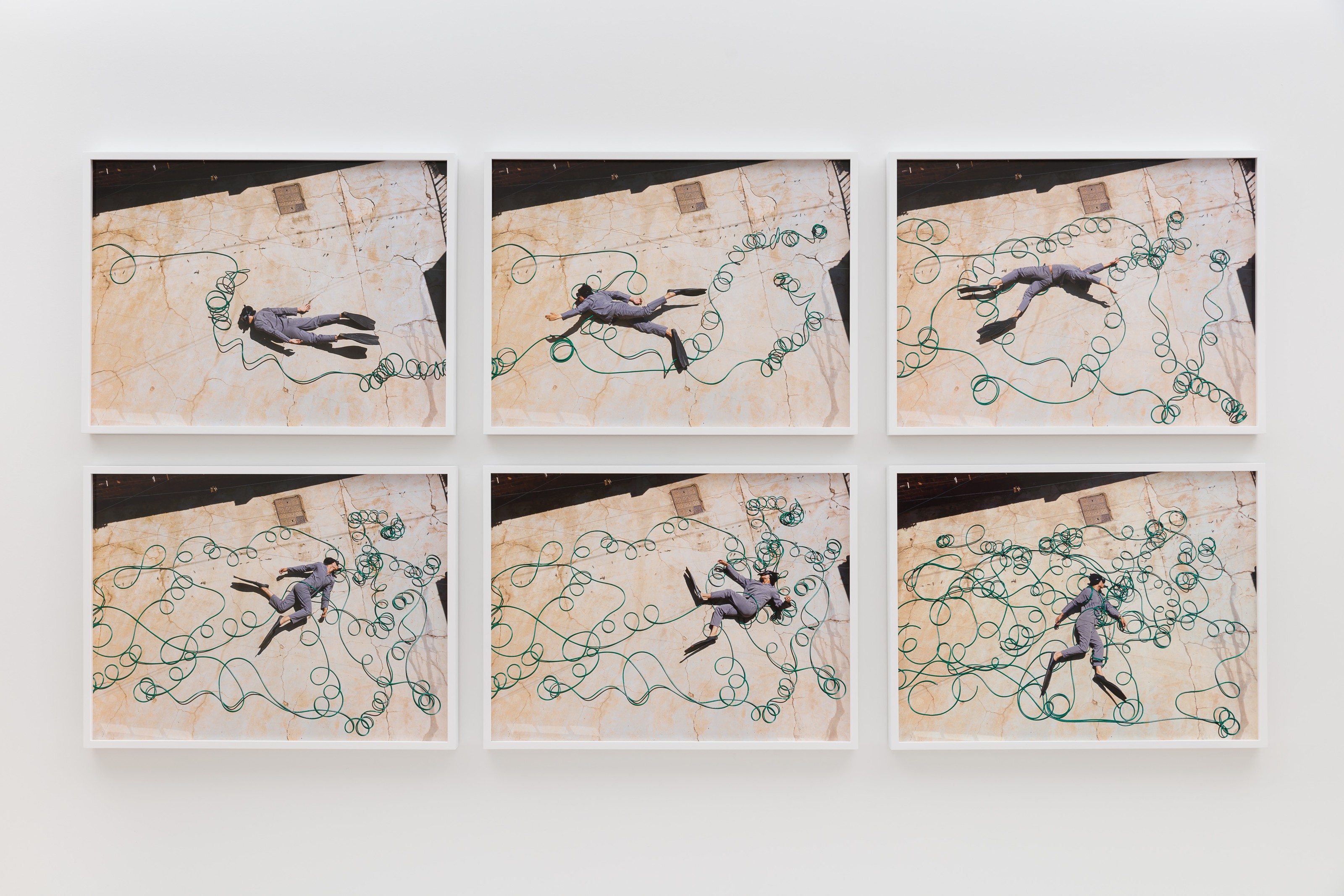
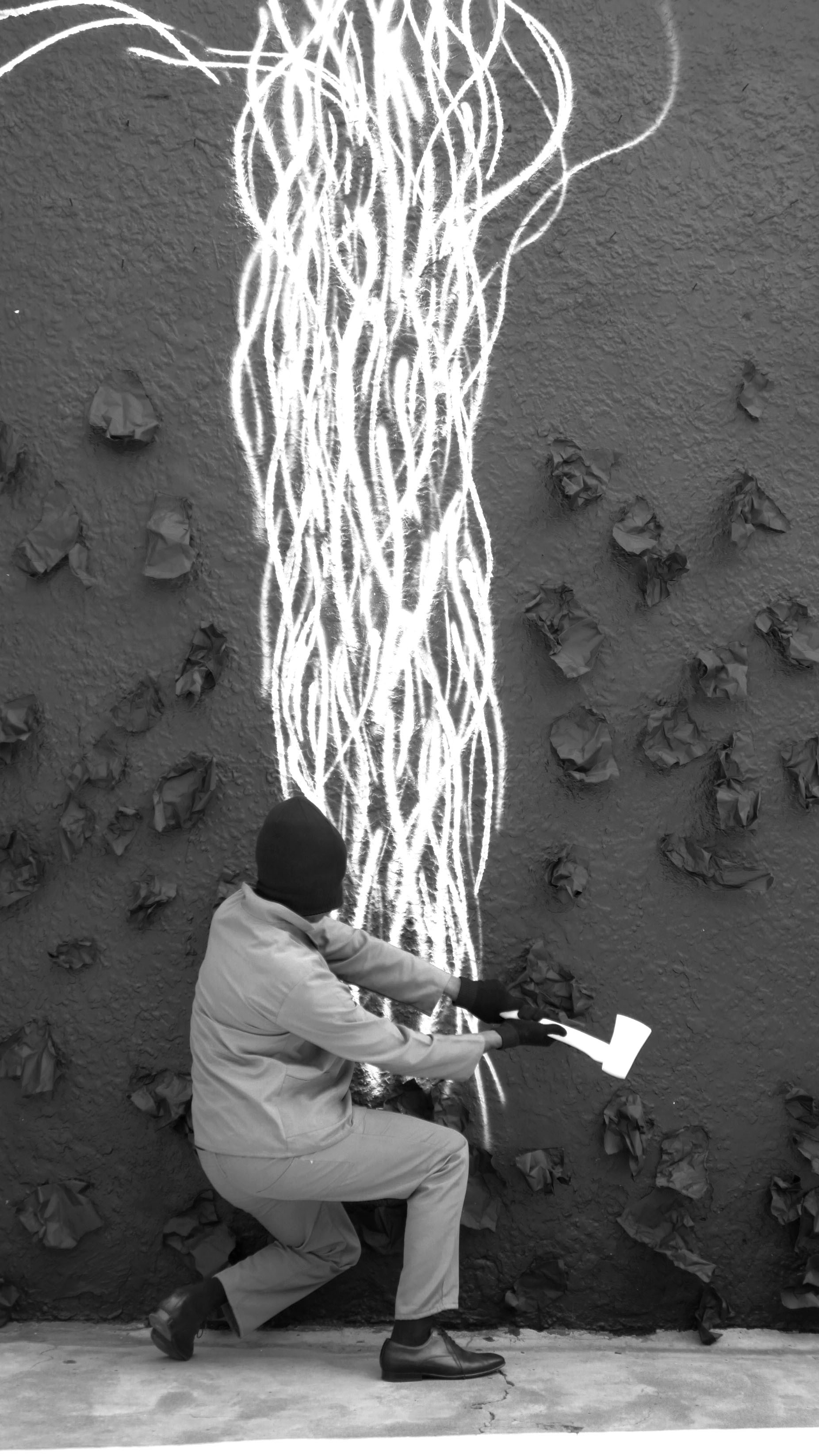
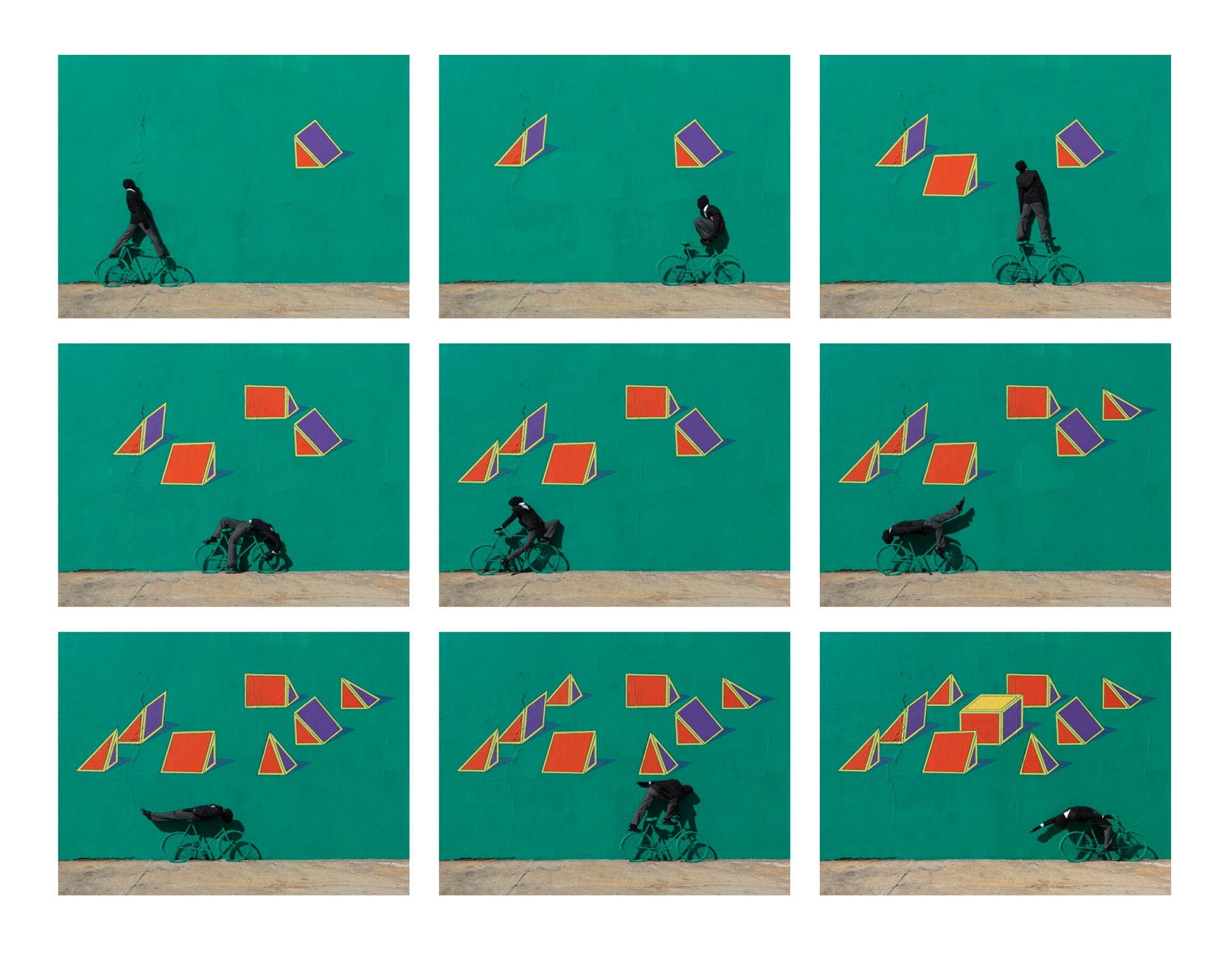
Lehmann Maupin London is pleased to present The Backyard is My World, an exhibition of work by South Africa-born, Berlin-based artist Robin Rhode. Working across (and often merging) media, including drawing, performance, street art, photography, and animation, Rhode is best-known for his serial photographs of his large-scale public wall drawings, in which figures interact with objects, vehicles, architecture, or abstract geometric shapes and patterns. Over the last two decades, Rhode has developed a distinct multidisciplinary body of work that engages numerous art historical influences, including graffiti, the minimal wall drawings of Sol Lewitt, 1970s performance art, and the stop-motion photography of Eadweard Muybridge. Rhode often draws from science, mathematics, history, artmaking, mythology, and politics to gain a deeper understanding of human beings and how they engage with the world that surrounds them. The Backyard is My World, the artist’s first solo exhibition in London since 2011, will feature photographs and animations produced over the last 10 years in a single location―the backyard of the artist’s family home in Johannesburg, South Africa.
In this exhibition, Rhode transforms the concrete surface of his backyard, turning it into a body of water, a mathematically inspired imaginary landscape, or a schoolyard playground. The yard functions as an outdoor studio of sorts, the concrete walls and ground offering a monochrome backdrop that transforms the flat visual plane into a three-dimensional space the artist activates using performers, found objects, and site-specific drawings. For Rhode, the backyard signifies comfort, joy, play, and security, allowing him to engage the innocence and freedom of his childhood unencumbered. Although this space has served as a canvas for the artist for over a decade, with the onset of the global pandemic Rhode’s return to the safe-haven of his family home sparked memories of his youth and offered a source of creative inspiration. This moment of reflection led to the reexamination of earlier work and the production of a new series that reveals a “return to basics,” where Rhode distills his compositions to concrete, line, and simple action.