

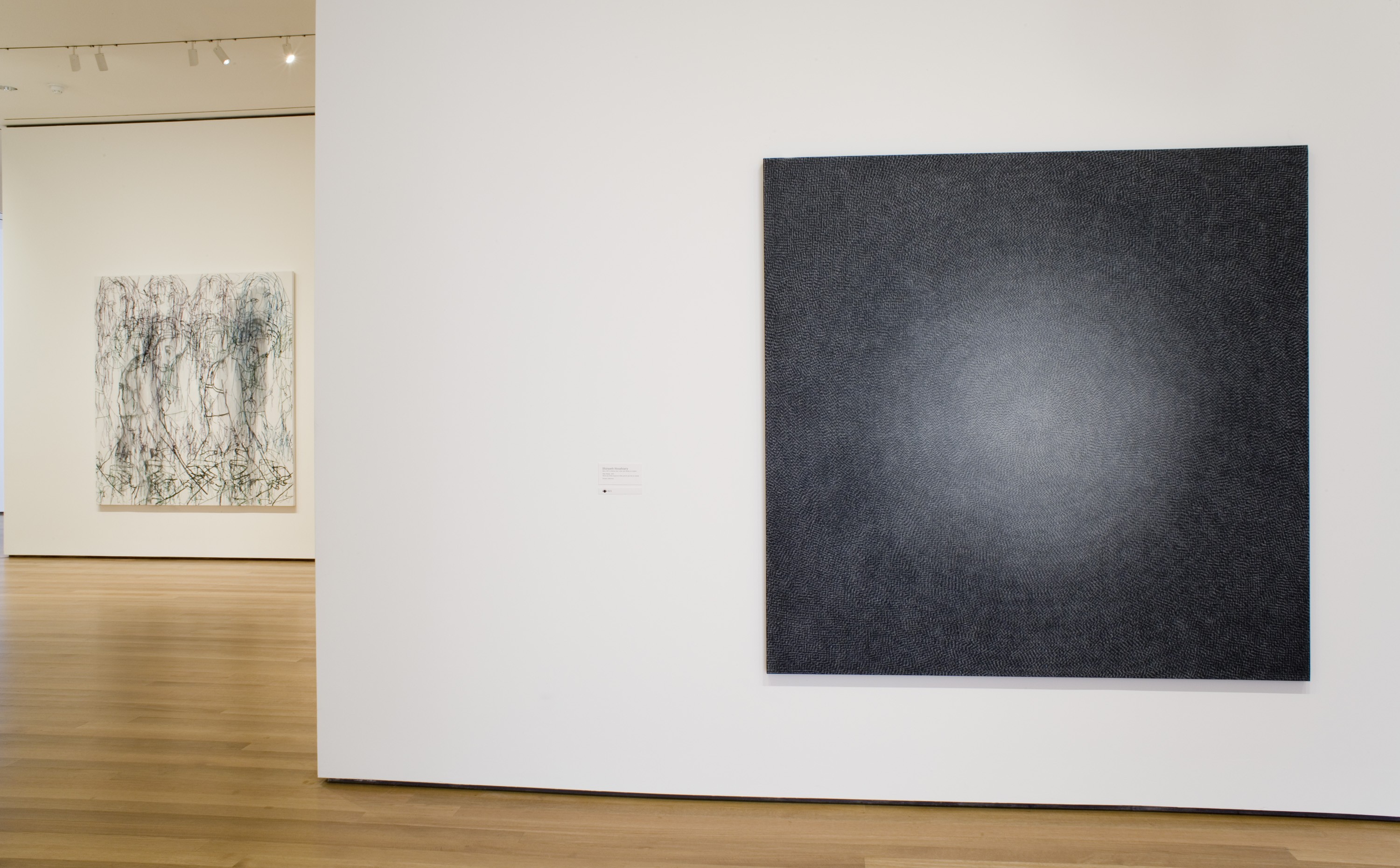


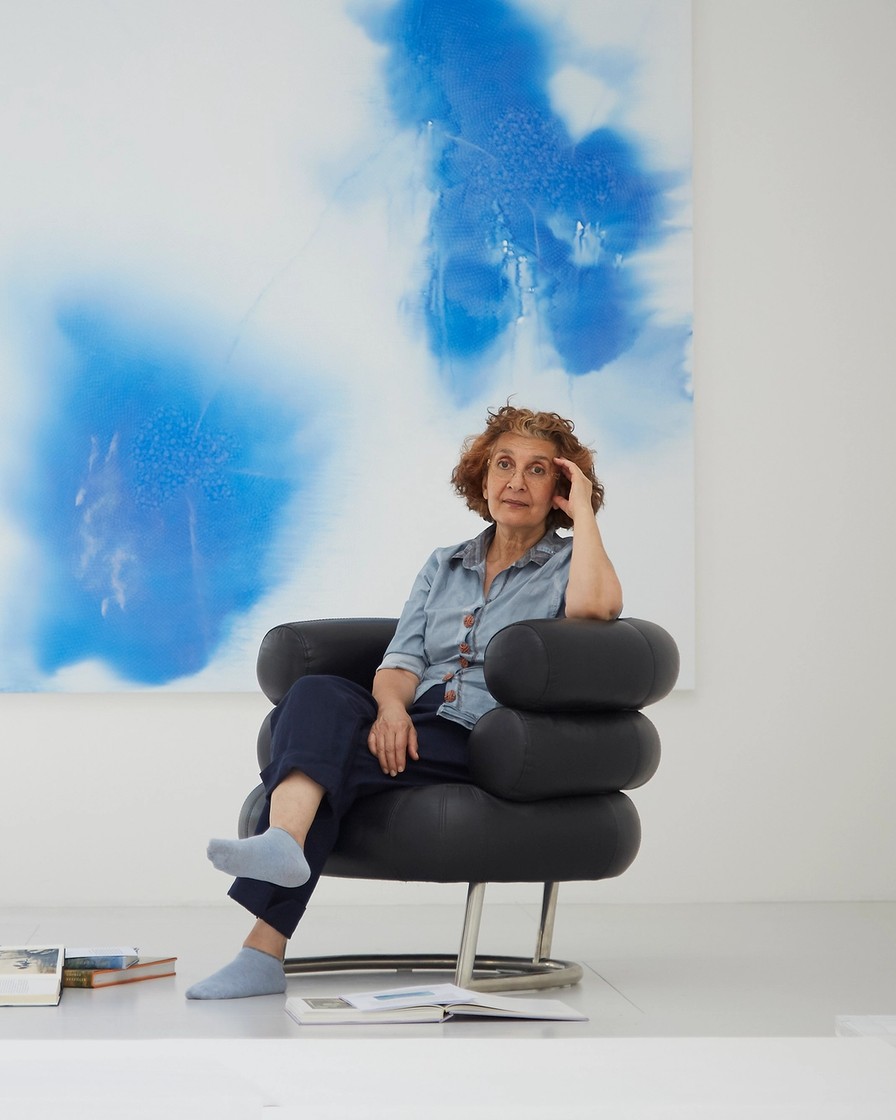
Shirazeh Houshiary (b. 1955, Shiraz, Iran; lives and works in London, United Kingdom) makes painting, sculpture, and animation that seek to challenge viewers’ perceptions of time, space, and materiality. Her works often engage opposing ideas and states of being, including transparency and opacity, sound and silence, surface and depth, and presence and absence. From a distance, her paintings are reminiscent of a swirling galaxy, but as the viewer draws closer, the meticulousness, detail, and hidden Arabic letters that make up her amorphous forms begin to unfold. The universe, with its contradiction, paradox, and complexity is a core subject matter in her work. The Arabic words embedded in her compositions are a juxtaposition of the opposing phrases “I am” and “I am not,” oscillating freely between focused and unfocused states, where the meaning of our existence becomes superfluous and lost in Houshiary’s imagined cosmos.
Houshiary’s painting technique involves the successive layering of pigment and line, a laborious process that often takes several months to complete. Her surfaces are composed of intricate patterns that appear to pulse, undulate, and recede into the canvas, like a veil or membrane. She takes a similar methodical approach to her dynamic sculptures, constructing towers out of glass or aluminum bricks that, layer by layer, seem to emerge from the floor. Each vertical plane of bricks echoes the original shape of the structure’s footprint incrementally rotated to the maximum degree the form will allow before the resulting helix shape becomes unstable. For each work, Houshiary attempts to visualize subjects that are inherently intangible—an echo, human breath, or memory.